Research-based Teaching with Citizen Science: Chances and Challenges for Future Skills in Higher Education
Integrating research-based teaching with Citizen Science at the BA and MA level introduces a wide range of learning opportunities. In this post, Melanie Brand discusses insights based on the 19-months teaching project “Citizens Consider(ed). AI and Sustainability in the Lake Constance Region”.

Photos: Sophie Tichonenko (KARLA Magazine, Konstanz)
This post is part of a larger blog series of the LERU Public Engagement focus group
Participatory and transdisciplinary research approaches are still rare in university curricula. Integrating research-based teaching with Citizen Science at the BA and MA level introduces a wide range of learning opportunities – for educators and for students alike. But it also comes with its own set of challenges.
Starting Point
The aim of Citizens Consider(ed) was to create and implement a concept for a cross-university teaching format enabling students to develop their own Citizen Science projects at the intersection of AI and sustainability. Our co-teaching team brought together expertise in Anthropology, Sociology, Science and Technology Studies, Citizen Science, participatory journalism, and photojournalism. With funding from the “Lake Constance Arts & Sciences Association” we invited interdisciplinary guest lecturers and offered student groups a budget to cover project costs.
Citizen Science and Future Skills
Introducing citizen science methodologies for students at the BA-level not only invites them to gain knowledge about the specific seminar topic at hand – in our case, AI and sustainability – but moreover provides them with the opportunity to acquire and practice so-called “Future Skills”:
Future skills are defined as those skills that enable university graduates to master the challenges of the future in the best way possible. Findings show that in order to deal with future challenges, students must develop curiosity, imagination, vision, resilience, and self-confidence, as well as the ability to act independently. They must be able to understand and respect the ideas, perspectives, and values of others, and they must be able to deal with mistakes and setbacks while moving forward mindfully, also when facing difficulties. (Ehlers 2019: 3, own translation)
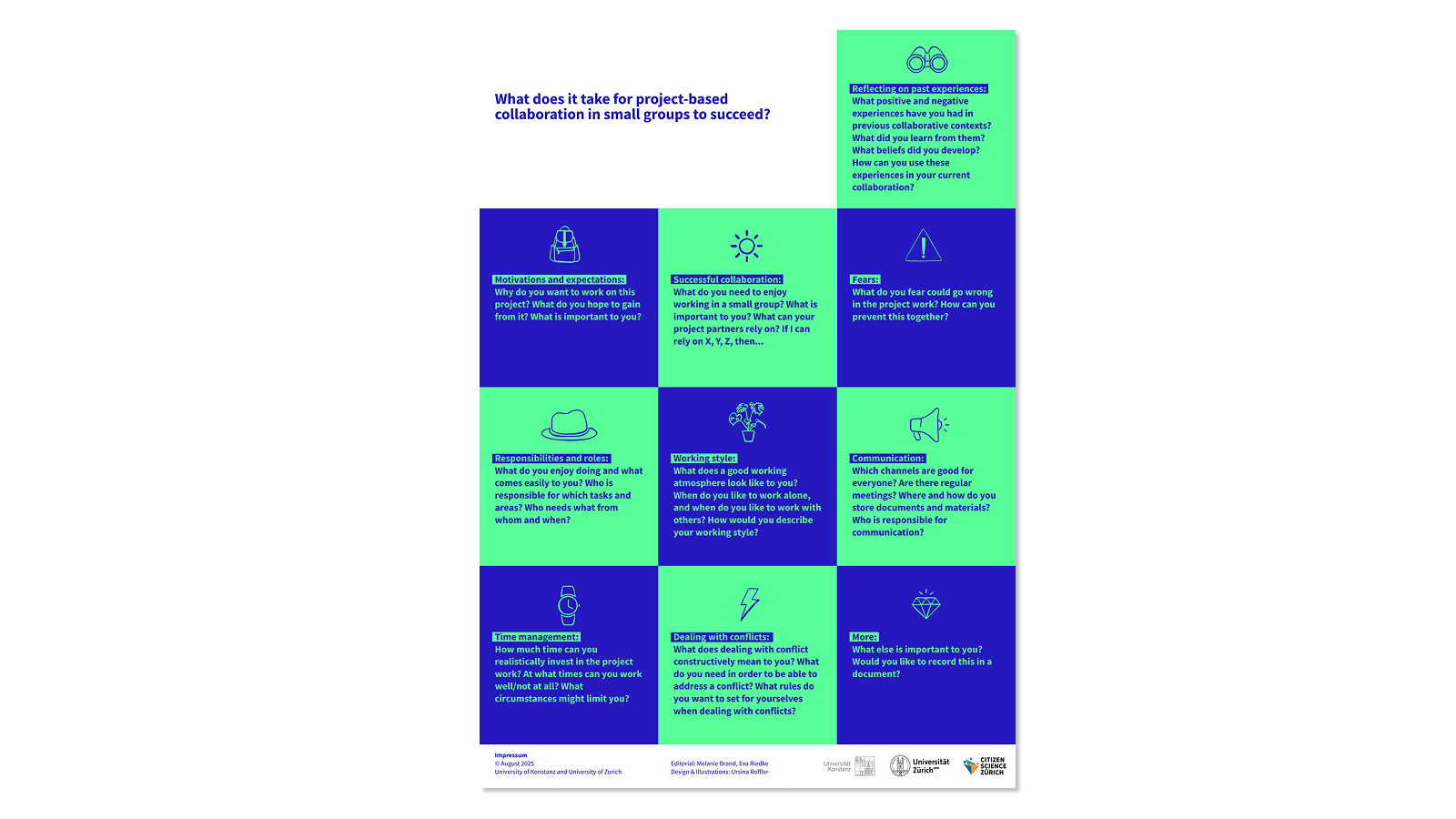
The seminar introduced students to participatory project work in scientific contexts giving them the opportunity to practice the following future skills: (1) process and self-reflection skills (e.g. guiding questions for successful collaboration), (2) project planning and organising skills, (3) groupwork and collaboration with other stakeholders. These skills and attitudes prepare students to work in heterogeneous, multi-stakeholder environments characterised by a plurality of perspectives, concerns, resources and restrictions, motivations, as well as ways of working and communicating – both inside and outside academia. To foster these competencies, we guided students through the process step by step, from identifying personal interests to forming working groups, selecting a research topic and possible citizen scientists, planning ways of engagement and possibilities and limits of co-research, to developing creative science communication frameworks to portray their results. The overarching question being: How can we design participatory projects that benefit everyone involved?
Moreover, the Citizen Science approach questions conventional academic ways of knowledge production. When part of the BA curriculum, it fosters critical thinking towards largely taken-for-granted institutionalised processes at an early stage of higher education.
Additional Information

Breaking the mold
Originally designed as an interdisciplinary two-semester seminar, institutional constraints forced us to redesign into a single semester course. The seminar was also breaking the mold in terms of design, students’ expectations, and the role of lecturers. Compared to other courses, this was not a conventional seminar. Hence, we and the students had to redefine what success would mean in this constellation and what the relationship between students and lecturers looked like.
Because of group work and collaboration with Citizen Scientists and other stakeholders, project success in conventional terms was highly dependent on others and beyond the control of the individual student. To lower the pressure, the final grade consisted of two equal parts: the documentation of the Citizen Science project (groupwork), and a (self-)reflection report (individual assessment). This allowed the focus to shift from the actual project outcome to process documentation, and gave students space to reflect on the groupwork process individually.
The tension between structure and openness, room for creativity and a sense of overwhelm were palpable from the start. Students needs and preferences differed immensely with some groups thriving and leaning into the creative space whereas others needed more guidance which we offered in regular consultations. Over time, students became more confident in taking their own decisions, weighing pros and cons and trust developed.
Furthermore, switching from “doing research about” to “doing research with” people did not come easily and reflects an early academic socialisation that clearly differentiates between those who study and those who are being studied. In Citizen Science projects, these lines get blurred while simultaneously asking to clearly define roles, responsibilities, and expectations, as otherwise, projects will succumb to chaos. Hence, the tension between pre-defined structures and openness was replicated on the level of students’ individual projects, making constant reflection of ongoing processes and adjustments a necessary part of project development.


The projects
In total, students developed seven Citizen Science projects covering a wide variety of topics at the intersection of AI and sustainability that engaged citizen scientists in different ways. Here a short overview to illustrate the scope of themes and approaches:
- Introducing Tree AI to schools. The student group organized a workshop at the botanical gardens, where pupils learnt about the biodiversity app “Tree AI” and, based on their experiences and observations, designed a flyer with recommendations for teachers.
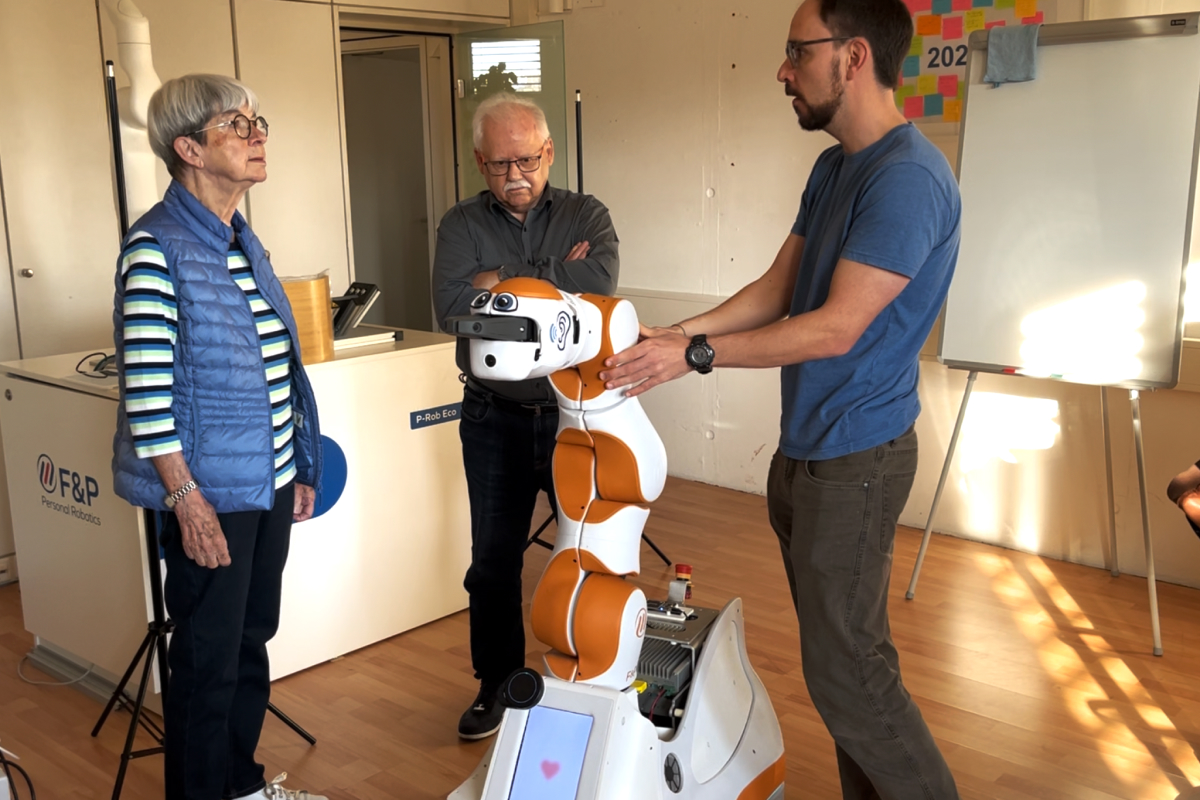
- Can a robot be a better conversation partner? Together with two employees from F&P Robotics and two senior citizen scientists, the student group organised a small workshop during which the Citizen Scientists had the chance to meet and talk to the care assistant robot “Lio” and later reflected on and analysed their experiences together.
- Konstanz on AI. The student group developed a concept for an interactive format in the city centre where passers-by could learn about AI and sustainability and share their opinions on posters and via interviews. Later, the data was analysed in a workshop with a smaller group of participants.
- On breast-level. The dialogue on AI in women’s health care. Together with Citizen Scientists, the group developed questions to be discussed with healthcare professionals to discuss the role of AI in the field of women’s health. Starting with a focus on early breast cancer detection, they together identified hopes, worries, and wishes regarding the use of AI in women’s medical care.
- How eco Am I? The student group opted for a similar approach like the Konstanz on AI group and invited passers-by in the city centre to reflect on their AI use in a wider ethical context. The collected insights were later analysed with co-researchers in a workshop.
- (No) interest in AI. The group decided to use the Citizen Science approach in a school environment, where together with pupils they reflected on their AI use and used self-reporting formats to identify different AI use cases.
- Konstanz Capture & Connect. This group used generative AI to create images of alternative cityscapes and third places that would foster ecological and/or social sustainability. Citizen Scientists entered prompts via a website and pictures were later discussed with a smaller group of participants in a youth centre.
Learnings and Outcomes: creativity is hard
While feedback indicates that students have been stressed by time constraints and would have preferred a two-semester course, many positive aspects were noted: Working with Citizen Scientists led students to feel more connected to the city and allowed them to refer to theoretical aspects in their field for application in practice. Engaging with Citizen Scientists made them realize that given an appropriate space, people are very interested to discuss current events and engage in research projects. They also felt taken seriously in their role as researchers which for many had been a prior concern. In general, students found appreciation and respect for collaborative research done right as they reflected on how much time, effort, flexibility and willingness to discuss, adjust, (co)create and recreate, open communication, clear boundaries and commitment it takes to plan and jointly develop co-creative projects.
Regarding the seminar concept, it would be interesting to explore other ways to balance the tension between structure and openness and find flexible methodologies that foster creativity and allow for growth without risking paralysis and overwhelm. A general question is how to demonstrate and assess future skills as in the case of Citizen Science, these always consist of both, an individual and a collaborative component.
If you have questions or want to connect, please feel free to reach out to melanie.brand@uzh.ch
The 19-months teaching project “Citizens Consider(ed). AI and Sustainability in the Lake Constance Region” was jointly developed by Melanie Brand (Citizen Sicence Zürich, UZH) with Dr. Eva Riedke (University of Konstanz) and Sophie Tichonenko (KARLA Magazine, Konstanz).